
Why the Money Investors Actually Receive Matters
By Mary Blaney | Proven Ventures
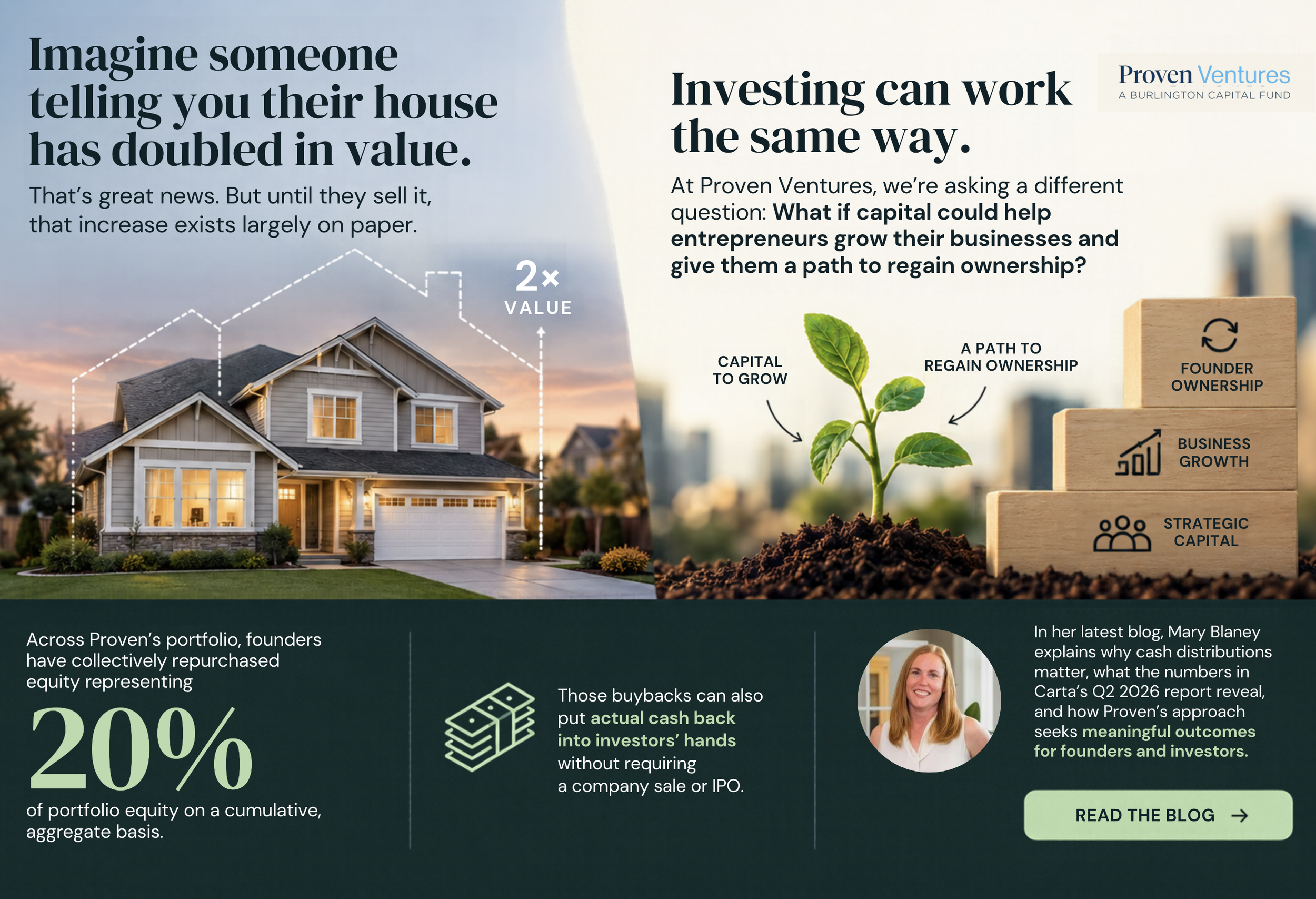
Imagine someone telling you their house has doubled in value.
That's great news. But until they sell it, that increase exists largely on paper.
Investing can work the same way.
In venture capital, we hear plenty about valuations. A company once valued at $5 million might now be worth $20 million. That's impressive growth.
But here's the question I always want to ask:
How much of that money has actually made it back to investors?
There's a big difference between what an investment might be worth and what investors have received in cash.
And the latest industry numbers help explain why that distinction matters.
According to Carta's VC Fund Performance Report: Q2 2026, venture capital funds are continuing to build value, but turning that value into cash distributions remains a challenge.
Consider this: The median fund established in 2017 has returned just 37 cents for every dollar investors contributed. For funds established in 2018, that figure drops to 15 cents. And for 2019 funds, it's just 4 cents.
That's several years of investing, growing companies and increasing valuations, with relatively little cash making its way back to investors.
It's an important reminder that a growing investment isn't necessarily a paying investment.
At Proven Ventures, we're approaching this challenge differently.
Our reported distributions-to-paid-in-capital ratio, or DPI, is 0.06x, compared with 0.04x at the 75th percentile for 2021 vintage venture funds, according to Carta's Q2 2026 reporting.
In plain English, that means Proven has returned 6 cents in cash for every dollar invested, compared with 4 cents at that 75th percentile benchmark.
That's 1.5 times the benchmark in cash distributions.
DPI doesn't tell the entire story of an investment's performance. It doesn't account for the remaining value of investments still held by a fund. But it answers one important question: How much actual cash has been returned?
And that's a number worth paying attention to.
What Makes Proven Different?
One way Proven generates cash distributions is through founder equity buybacks.
Traditional venture capital often depends on a company being sold or going public before investors receive significant cash returns.
Proven's investment approach creates another opportunity.
As portfolio companies grow, founders have opportunities to repurchase equity in their businesses. Those transactions can generate cash distributions for investors while allowing entrepreneurs to regain ownership.
In fact, founders across Proven's portfolio have collectively repurchased equity representing 20% of the portfolio's equity on a cumulative, aggregate basis.
It's an approach designed to create meaningful outcomes on both sides of the investment.
Investors receive opportunities for cash distributions. Founders gain opportunities to own more of the businesses they've worked to build.
Valuations matter. Business growth matters. And long-term investment performance certainly matters.
But so does the ability to turn that growth into actual cash distributions.
At Proven Ventures, we're focused on building a model where investor returns and founder ownership can work together.
Because a good investment story should be about more than what something might be worth someday.
It should also be about the money actually making its way back to investors.
And that's why we believe cash returns deserve a place in the conversation.
Source: Carta, VC Fund Performance Report: Q2 2026, published September 23, 2026.
Performance note: Proven's reported 0.06x DPI is compared with Carta's 0.04x DPI at the 75th percentile for 2021 vintage funds. The 20% equity buyback figure represents the cumulative, aggregate amount of equity repurchased across Proven's portfolio and is not a Carta statistic. DPI measures cash distributed relative to paid-in capital, not total investment return. Past performance does not guarantee future results.